How to Follow Through on Intentions (And Why Most Advice Makes It Harder)
You set the intention. You felt genuinely motivated. Maybe you even wrote it down or told a friend. And then... nothing. Sound familiar?
Here's the frustrating truth: most people don't struggle with setting intentions. They struggle with following through on them. And the advice floating around online, things like "just stay disciplined" or "build a habit loop," often misses the bigger picture entirely. In some cases, it actually makes the problem worse.
So if you've ever wondered how to follow through on intentions without burning out or white-knuckling your way through every obstacle, this post is for you. We're going to dig into why the standard advice falls short, what's actually getting in the way, and the practical steps that make follow-through feel less like a battle and more like a natural progression.
No fluff, no recycled productivity tips. Just a clear, honest breakdown of what works, backed by a better understanding of how your brain and behavior actually operate. By the end, you'll have a concrete framework you can start using today.
You Already Know What You Want to Do. So Why Aren't You Doing It?
You've mapped it out. You know exactly what you want to change. Maybe you've even written it down, talked about it with a friend, or felt that surge of clarity at midnight when everything suddenly seemed possible. And then... nothing happens. Or something happens for a week, and then it quietly doesn't anymore. If that cycle sounds familiar, you're not broken. You're experiencing one of the most well-documented phenomena in behavioral psychology.
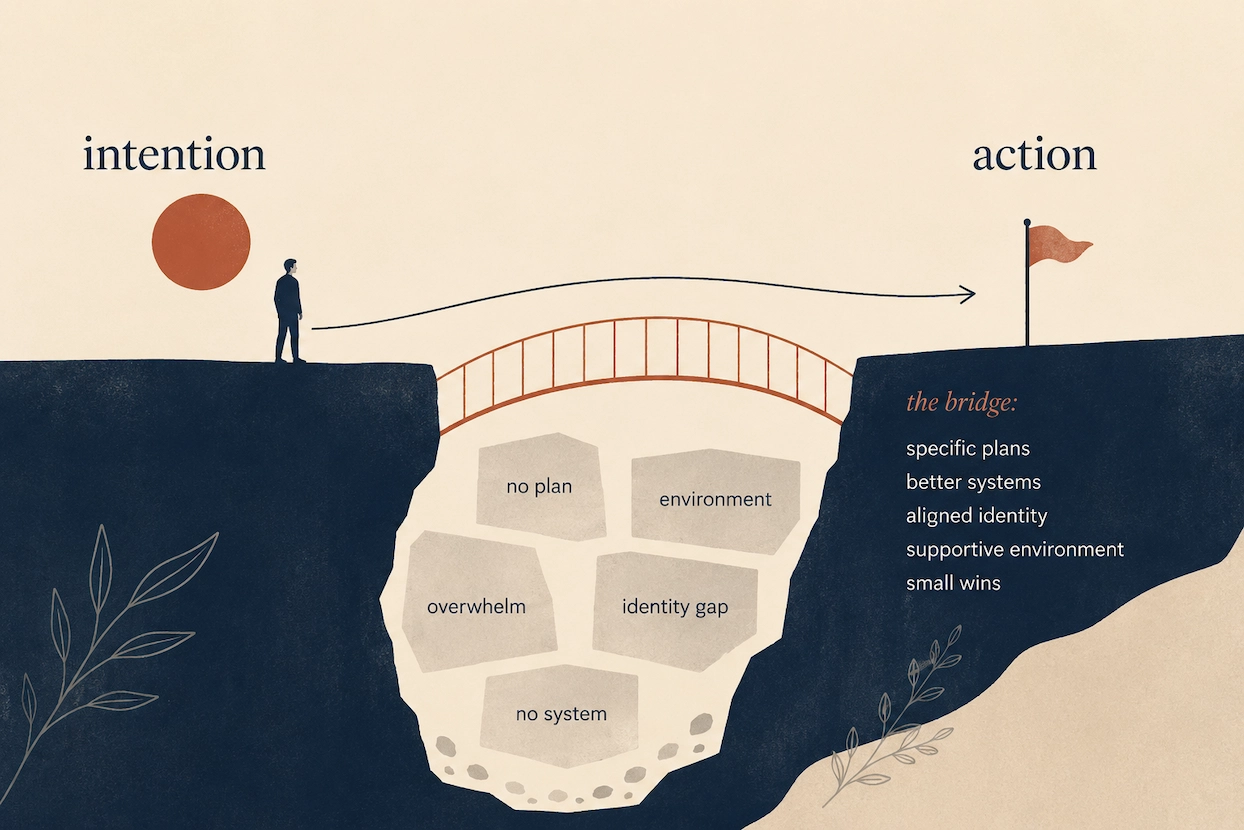
The intention-behavior gap is the term researchers use to describe the stubborn disconnect between what we plan to do and what we actually do. It's not a motivation problem or a discipline problem. Studies show that intentions alone explain only about 28% of the variance in actual behavior, meaning the other 72% comes down to structure, environment, and systems that most people never think to build. You can want something deeply and still not do it, because wanting was never the mechanism that drives follow-through.
The scale of this is worth sitting with. Research by Norcross and Vangarelli found that roughly 92% of people fail to achieve their stated goals, not because they didn't care enough, but because caring isn't a system.
There's also an important distinction hiding inside this problem. Surface-level habit goals ("I'll go to the gym three times a week") are hard enough. But identity-level intentions ("I want to become someone who takes their health seriously") are a different category entirely. They require shifting how you see yourself, not just adding a new behavior to your calendar. That's what makes them feel so loaded and so easy to keep postponing.
The rest of this article isn't going to ask you to want it more. It's going to show you the structural changes that actually close the gap between intention and action.
Why Intention Barely Predicts Behavior (The Research Will Surprise You)
Here's something that might genuinely change how you think about this problem. That feeling of being stuck, despite knowing exactly what you want? It's not a character flaw. It's actually built into the math.
Research psychologist Paschal Sheeran conducted a sweeping meta-analysis pulling together 422 separate studies covering more than 82,000 participants. His finding was striking: intention predicts only about 28% of actual behavior. That means the other 72% of what you actually do comes from factors that have nothing to do with how much you want something. Even when researchers expand that estimate to account for more favorable study conditions, the ceiling lands around 40%. You can want something deeply, sincerely, and with complete clarity, and that still leaves the majority of the behavioral equation unexplained.
It gets more specific in health contexts, where the stakes feel highest. Studies on health-related goal pursuit show that people act on their good intentions only about 53% of the time. Flip that around: nearly half of people who genuinely intend to make a healthy change never actually make it. Not because they stopped caring, but because intention and action are two entirely separate cognitive events.
This is the part most people get wrong. The assumption is that if you just wanted it badly enough, you'd do it. But the behavioral science is consistent on this point: the gap between intention and action is primarily a structure and environment problem, not a willpower or motivation deficiency. The brain doesn't treat a formed intention as a starting gun. It treats it more like a completed task. Neurologically, declaring an intention creates a kind of psychological closure, a quiet signal that says "handled," which actually reduces the urgency to follow through. Without a concrete plan that links a specific situation to a specific action, the intention just floats there, unconnected to anything that would trigger it in real life.
This explains something you may have experienced firsthand. If you've tried journaling apps, habit trackers, or goal-setting frameworks and still feel stuck, it's not because those tools are useless. It's because most of them are very good at helping you form and record intentions, and far less equipped to handle what comes next. Awareness of a goal is not the same as having a system that moves you toward it. The research is clear: what closes the gap is structure, specific planning, and environmental support, not more motivation, more reflection, or a better-looking dashboard.
Why Habit Trackers and Journals Don't Close the Gap
So you've probably already tried the obvious solutions. Maybe you downloaded a habit tracker and kept your streak alive for three weeks before life got busy. Maybe you filled half a journal with honest reflection about what you want and why it matters. Maybe you even tried a coaching program or a generic AI tool that felt encouraging in the moment. And yet, here you are. Still in the gap.
This isn't a coincidence, and it's not a willpower problem. Each of those tools was solving a real problem, just not the whole problem.
Habit trackers measure what you did, not who you're becoming. When your entire relationship with a goal lives inside a checkbox, you're optimizing for the streak rather than the identity shift underneath it. Research consistently shows that lasting behavior change requires moving from outcome-focused thinking ("I want to run a 5K") to identity-based thinking ("I am someone who runs"). Trackers rarely prompt that deeper question. Worse, the streak mechanic can backfire. Miss one day and the whole system feels broken, which is why so many people abandon apps entirely rather than just resuming the next morning.
Journaling gets closer, but it stays private. There's real value in surfacing your own patterns through reflection. The problem is that journaling is a closed loop with only one person in it. Without external accountability, follow-up, or anything that pushes back on your reasoning, reflections tend to stay reflections. You can write "I need to stop procrastinating on my career pivot" every Sunday for six months without that sentence ever converting into a Thursday action.
Generic AI tools and coaching programs often feel great without actually building agency. Validation is comfortable. But research on how intentions translate to behavior shows that feeling supported and actually changing behavior are two very different outcomes. A tool that agrees with everything you say and cheers every plan rarely challenges the assumptions keeping you stuck.
The pattern here is familiar if you're in your 20s or 30s. You cycle through tools that each solve one piece: tracking for visibility, journaling for reflection, coaching for motivation. But none of them integrate the three things that the science of goal achievement points to consistently: external commitment, frequent monitoring, and identity anchoring working together.
That combination is the actual structure of follow-through, and it's what most tools leave out.
Step 1: Anchor Your Intention to Who You Are Becoming
Here's where most people's good intentions quietly fall apart before they even get started. The intention itself is framed the wrong way.
There's a meaningful difference between an outcome intention and an identity intention. An outcome intention sounds like: "I want to run a marathon" or "I want to get promoted this year." It's pointed at a result, a finish line, something external to you. An identity intention sounds different: "I am becoming someone who takes their health seriously" or "I am becoming the kind of professional who leads with confidence." One focuses on what you want to get. The other focuses on who you are becoming.
That distinction matters more than it sounds.
Identity-based framing increases persistence because it ties your actions to your self-concept rather than to an external reward. When the behavior reflects who you are, not just what you want, it becomes self-reinforcing. Every small action, a 10-minute walk, a difficult conversation you didn't avoid, becomes evidence for a belief you hold about yourself. Motivation rooted in outcome can evaporate the moment progress stalls or life gets complicated. Motivation rooted in identity is stickier, because abandoning the behavior means contradicting your own sense of self.
Behavioral science backs this up. Peter Gollwitzer's implementation intentions research, the work behind "if-then" planning, shows that bridging the gap between intention and action requires more than wanting something. The strongest follow-through happens when goals are connected to something deeply personal, not just logistically planned.
Try This Reframing Exercise
Take one intention you're currently carrying. Write it down as an outcome statement first, whatever version is already in your head. Then ask yourself: "Who is the kind of person that would naturally do this?"
Rewrite it as a claim about who you are working to become.
"I want to write a book" becomes "I am becoming someone who shows up consistently to create."
"I want to save more money" becomes "I am becoming someone who makes intentional choices with their finances."
Notice how the second version gives you something to act from, not just aim at.
This step is the foundation everything else builds on. If you skip it and jump straight to tactics, schedules, or accountability systems, your follow-through stays fragile because it's resting on motivation that shifts. Anchor the intention to identity first, and every subsequent step has something solid to attach to.
Step 2: Build an If-Then Plan Around Every Intention
Once you have your intention anchored to the person you are becoming, the next move is to give it a specific trigger. This is where implementation intentions come in, and they are simpler than they sound.
An implementation intention follows one format: "If [situation], then I will [action]." That is the whole framework. The key is that you are pre-deciding your behavior before the moment of choice arrives, before you are tired, distracted, or negotiating with yourself about whether you really feel like it today.
Why This Works (The Science Is Genuinely Compelling)
In a landmark meta-analysis of 94 independent studies involving over 8,000 participants, psychologists Peter Gollwitzer and Paschal Sheeran found that implementation intentions produced a medium-to-large effect on goal achievement, with a Cohen's d of approximately 0.65. In practical terms, that effect size roughly doubles your success rate compared to holding a goal intention alone. This is not a small difference. It is one of the most robust findings in behavioral science across health, career, and personal development contexts.
The reason if-then plans work so well is that they offload the decision to the environment itself. Instead of relying on willpower in the moment, you have already made the decision. When the cue appears, the response follows almost automatically, with less mental effort and less room for hesitation to creep in.
Vague Plans vs. Real Implementation Intentions
Here is a distinction worth sitting with. "I'll work on my portfolio when I have time" is not an implementation intention. It has no trigger, no specificity, and no real commitment. It lives permanently in the future. An effective if-then plan identifies a concrete, observable cue: a time, a place, a preceding action, or even an emotional state.
Compare these directly:
Vague: "I'll start networking more soon."
Effective: "If it is Wednesday at 8:00 PM and I have closed my laptop after dinner, then I will send one personalized message to someone in my target industry."
Vague: "I want to get back into exercising."
Effective: "If I walk through my front door after work, then I will immediately change into workout clothes before sitting down."
Vague: "I need to make more time for my creative work."
Effective: "If it is Sunday morning and I have made my coffee, then I will write for 30 minutes before opening any social media."
Each of these connects a real-world cue to a specific action, which means your environment does part of the work for you. The situation becomes the reminder, the prompt, and the trigger all at once. That is how you stop relying on motivation that was never designed to be consistent in the first place.
Step 3: Write It Down and Say It Out Loud to Someone
There is solid research behind this step. Dr. Gail Matthews, a psychology professor at Dominican University of California, ran a study with 267 participants to test exactly how much writing and accountability move the needle. The group that wrote their goals, made specific action commitments, shared those commitments with a supportive friend, and sent weekly progress reports achieved approximately 42% more than the group that only thought about their goals. That gap is not small. It is the difference between intentions that quietly fade and intentions that actually become part of your life.
The reason writing works comes down to externalization. When an intention lives only in your head, it is easy to soften, reframe, or forget entirely without ever consciously deciding to give up. The moment you write it down, it becomes a concrete object in the world. It can be reviewed, questioned, and compared against your actual behavior. Writing also engages more cognitive processing than passive thinking, which deepens your sense of ownership over the goal.
Sharing adds a second layer entirely. When another person or system knows what you have committed to, your reputation and sense of consistency are on the line. That is not a bad thing; it is exactly the kind of friction that bridges the gap between planning and doing. The Matthews study showed a clear dose-response effect: sharing once helped, but adding weekly check-ins helped even more.
One distinction worth making: vague sharing does almost nothing. Telling someone "I want to get healthier" gives them nothing to hold you to. Effective commitment sharing sounds more like: "I am going to cook dinner at home four nights this week. I am starting Monday, and I will text you by Sunday with how it went." Specificity is what creates real accountability.
So here is your practical move: write your intention, attach the if-then plan you built in Step 2, and name the specific person or system that will follow up with you. Not someday. Today.
Step 4: Build Scheduled Check-Ins With Real Follow-Up
A meta-analysis of 138 studies, published in Psychological Bulletin, found something worth paying attention to here. Goal-achievement effects were strongest when progress monitoring was frequent, when outcomes were made public, and when information was physically or self-recorded. Not occasional. Not whenever you feel like it. Frequent, structured, and documented. That finding alone should reshape how you think about check-ins.
But here is the part most people miss. Not all check-ins are equal.
Accountability without follow-up on specific prior commitments is just encouragement. There is a real difference between someone asking "how are things going?" and someone asking "last Tuesday you said you were going to send that application by Friday. Did you?" The first feels supportive. The second is actually accountability. Without revisiting the exact action you committed to, a check-in becomes an emotional reset, a chance to feel motivated again without examining what actually happened. That emotional boost fades fast.
An effective check-in has a clear structure. It revisits the specific action you committed to in the previous session. It asks what happened, honestly, including what got in the way. Then it names the next concrete step before the conversation ends. That three-part rhythm creates continuity. It builds a real record of your patterns over time, not just a log of your intentions.
The most common failure mode looks like this: sporadic check-ins that happen when motivation dips, each one wiping the emotional slate clean without ever surfacing why the same obstacles keep reappearing. You leave feeling recharged but no closer to understanding yourself.
This is exactly the mechanic Naru is built around. Its conversational check-ins follow up on actions you actually committed to, and the AI pushes back rather than simply validating whatever you say. That distinction, encouragement versus real follow-through, is where most tools fall short and where consistent progress actually begins.
Step 5: Track the Pattern, Not Just the Action
Follow-through is not just a matter of trying harder. It is a skill that compounds over time, and the raw material it runs on is self-knowledge. Every time you notice what worked, what derailed you, and what excuse showed up again, you are building a clearer picture of how you actually operate. That picture, accumulated over months rather than days, is worth far more than any single moment of motivation.
The problem with most tracking approaches is that they stay at the surface level. Checking off whether you completed an action today tells you almost nothing about the deeper pattern underneath. What you really need to know is: which types of intentions do you consistently follow through on, and which ones quietly slip? What contexts reliably derail you, whether that is a stressful week, a social stretch, or a change in routine? Which excuses keep recycling in slightly different costumes? A single check-in cannot answer these questions. Even a weekly review barely scratches the surface. The signal only becomes legible when you zoom out.
This is where compounding memory becomes genuinely powerful. Months of recorded check-ins can surface something no isolated entry ever could: for example, that you reliably execute professional commitments but consistently deprioritize personal ones, or that your follow-through drops sharply after high-social weeks. These are not things you can reason your way to in one sitting. They emerge from the accumulation.
That accumulated picture also feeds directly back into the identity work from Step 1. When you can see your own track record, you are not just hoping you are becoming someone who follows through. You are building evidence for it. That evidence strengthens the self-concept you are actively constructing, making the next intention easier to keep.
Most tools, unfortunately, reset on a weekly or monthly cycle, which is precisely the wrong window for identity-level goals. Streaks break, data disappears, and the longer arc of your story gets lost. A system that holds your history, surfaces patterns across months, and treats your progress as a continuous narrative rather than a fresh start every thirty days offers something proportionally more valuable for the kind of growth that actually changes who you are.
The Part Nobody Mentions: Scaffolding Should Eventually Get Out of Your Way
Here is something that often gets left out of the conversation about building better habits and following through consistently. The support structures you use at the start are not meant to be permanent fixtures. They are meant to build you, not replace you.
This idea comes from educational psychology, where it is called scaffolding. The concept is straightforward: you provide support that enables someone to perform just beyond their current ability, and then you gradually remove that support as their capacity grows. The same logic applies to behavioral change. Early prompts, check-ins, and accountability structures help you initiate repetition and build momentum. But the explicit goal is always internalization, not indefinite reliance.
The dependency trap is subtle, so it is easy to miss. When a tool or system keeps you reliant on it indefinitely without ever stepping back, it is not actually serving your development. It is just filling the gap permanently rather than helping you close it. Sustainable behavior change requires a shift from external motivation toward internal drivers: identity, automatic cues, and genuine self-regulation.
Healthy scaffolding fade looks deliberate. Early on, the system does more: more frequent check-ins, more structured prompts, more explicit accountability. Over time, as your own voice and self-awareness develop, it steps back. The prompts become subtler. The check-ins become more spaced. You start initiating instead of responding.
This is the design philosophy behind Naru. A good accountability system is actively working toward making itself less necessary. The whole point of learning how to follow through on intentions is not to always need an outside push. It is to become someone who follows through naturally, because that is simply who you are now.
Following Through Is a Skill You Can Actually Build
The five steps covered in this guide form a complete system: anchor your intention to identity, build an if-then plan around it, write it down and commit externally, schedule real check-ins, and track the compounding pattern over time. Each step addresses a specific breakdown point in the chain between intention and action. Together, they do something that motivation alone never can; they create structure that carries you forward even when your energy dips.
Here is the honest part, though. Maintaining that structure on your own is genuinely difficult, especially for identity-level goals that do not come with a boss, a team, or a deadline holding you accountable. Nobody is going to notice if you quietly abandon the person you were working to become.
That is exactly the gap Naru was built for. Not a habit tracker, not a journal. Naru is a conversational AI companion anchored to your meaningful life goals, with memory that accumulates over time and built-in follow-up on what you actually commit to. It initiates check-ins, pushes back instead of just validating you, and makes sure every session ends with a concrete next step.
Right now, before you close this tab, try this: take one intention you are currently holding and rewrite it as an identity claim. Then pair it with a specific if-then plan. That single move activates the two highest-leverage elements in this entire framework immediately.
The gap between who you are and who you are becoming is not a motivation problem. It is a design problem, and that means it is fully solvable.
Conclusion
Following through on intentions was never about trying harder. It's about understanding yourself better.
Here's what actually matters: your brain resists vague commitments, so specificity is everything. Environment shapes behavior more than willpower ever will. And identity, not discipline, is the real engine behind lasting change. When you stop fighting your nature and start working with it, follow-through stops feeling like a battle.
The standard advice fails because it treats motivation as a moral issue. It isn't. It's a design issue, and you can redesign your approach starting today.
So pick one intention you've been avoiding. Make it concrete, shrink it down, and remove one obstacle standing in your way. That's it. Start there.
Progress rarely looks dramatic at first, but consistency built on the right foundation always compounds. You don't need more willpower. You need a better system.
Ready to become who you meant to be?
naru helps you articulate goals, stay honest with yourself, and follow through.
Try naru free