8 Things Worth Asking AI (And One Most People Haven't Tried)
Most people open up an AI chatbot, type something simple, get a halfway decent answer, and then close the tab thinking, "Well, that was fine, I guess." But here is the thing: they are barely scratching the surface of what these tools can actually do for them.
If you have been curious about how to ask AI the right questions, you are in the right place. Whether you have never used an AI tool before or you have played around with one a few times, this post is going to show you some genuinely useful ways to put it to work in your everyday life.
We are breaking down eight practical things worth asking AI, covering everything from everyday tasks to creative problems you probably did not think it could help with. And we saved one idea for last that most beginners completely overlook, but it might end up being your favorite.
No technical knowledge required. No complicated setup. Just simple, honest guidance to help you get more out of every conversation you have with AI. Let's jump in.
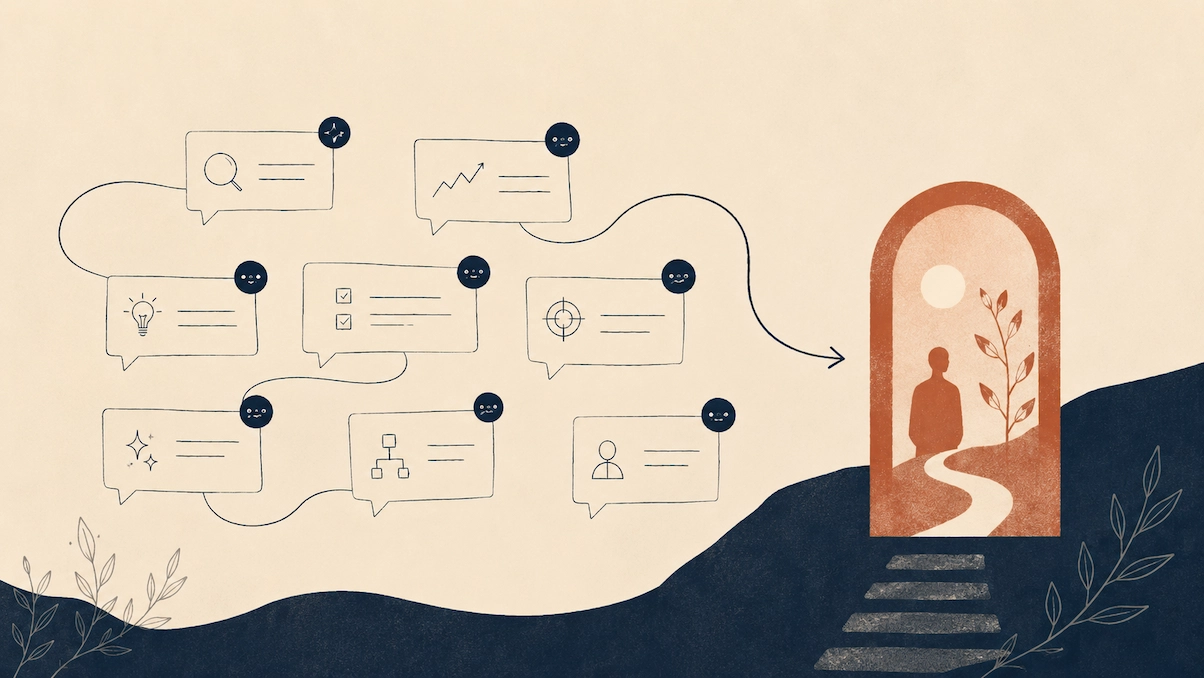
Why the Question You Ask AI Changes Everything
Most people treat AI like a fancier search bar. You type in a question, you get an answer, you move on. And for quick tasks, that works fine. But that approach barely scratches the surface of what's actually possible.
The more useful shift is treating AI as a thinking partner rather than an answer machine. When you engage in a real back-and-forth, push on the first response, add context, and ask follow-up questions, the quality of what you get back changes dramatically. Research into how people actually use AI shows a clear pattern: the people getting the most out of it aren't just asking better questions. They're building actual dialogues.
Here's the part that matters most: vague inputs produce vague outputs. If you ask something generic, you get something generic back. The more specific and honest you are about what you're actually trying to figure out, the more useful the response becomes. This isn't a quirk of the technology. It's the whole game.
And yet, according to current AI usage data, the most common uses are still things like drafting emails and summarizing content. Meanwhile, the use case with arguably the most upside, using AI to work through your own life goals and figure out where you're stuck, is the one most people keep putting off.
That's exactly what this piece is about. We'll cover the practical stuff, but we'll also get to the question most people keep postponing: what happens when you actually ask AI something real?
Get Instant Research Without Falling Down a Rabbit Hole
One of the most practical ways to ask AI for help is as a fast-track research assistant. Instead of opening fifteen tabs and losing an hour to related articles, you ask a direct question and get a structured answer in seconds. This works especially well when you need to get up to speed on something quickly, without becoming an expert in it.
Think of it this way: you have a meeting tomorrow about negotiating your salary. You don't need a 40-page guide. You need the essentials, right now. A prompt like "Give me the three most important things to know about negotiating a raise before I go in tomorrow" gets you exactly that: prioritized, actionable points with no fluff. Same approach works for comparing two options, understanding a topic you've never touched, or getting context before a conversation where you want to sound prepared.
This method works best with bounded, factual questions that have a clear endpoint. "What are the pros and cons of freelancing vs. a full-time role for someone early in their career?" is a great AI question. "What should I do with my life?" is not, at least not as a research prompt.
One important caveat: AI can confidently state things that are just wrong. It's called hallucination, and it still happens with current models. For anything low-stakes, the risk is minimal. But if you're acting on specific numbers, legal details, or medical information, verify those claims through a primary source before you move on it. Treat the AI output as a solid starting point, not the final word.
Draft, Edit, and Pressure-Test Anything You Have to Write
Writing is where a lot of people get stuck in their own heads. You've been staring at that email for 45 minutes. You know what you want to say, but something feels off and you can't pinpoint what. This is exactly where asking AI earns its keep.
The use cases here are more practical than people expect: cover letters that aren't landing, performance self-assessments that feel either too braggy or too flat, difficult messages you've been putting off for days, pushback emails where you need your argument to actually hold up. You can ask AI to rewrite something in a clearer tone, tighten a rambling paragraph, or make the whole thing sound less defensive. That alone saves real time.
But the more powerful move is pressure-testing. When you're too close to something, you stop seeing the gaps. Try a prompt like: "Here's my email pushing back on this decision. Where does my reasoning fall apart?" You'll often get back exactly what a skeptical reader would catch, without the social awkwardness of asking a colleague to critique your draft. University of Iowa's guidance on AI as reviewer puts it well: use AI to test your thinking, not just polish your words.
The key is to write your rough version first, then bring AI in to sharpen it. That way you keep your voice. According to research on AI writing workflows, this approach produces cleaner output and fewer revision cycles than asking AI to generate from scratch. For high-stakes writing, that distinction matters.
Think Through a Decision Before You Commit
Most big decisions feel clear enough in your head until someone actually pushes back on them. That's exactly what AI can do for you here, and it's one of the more underrated ways to use it.
Instead of asking "What should I do?", try handing AI your reasoning and asking it to poke holes in it. Something like: "I'm thinking about leaving my job in six months. Here's my reasoning. What am I not seeing?" Then actually give it the reasoning. The timeline, the financials, the personal factors, what you're hoping to gain, what you're nervous about. The more specific you are, the more useful the output.
This shifts AI from an answer machine into something closer to a thinking partner in dialogue. It's a fundamentally different role, and a much more valuable one. You're not outsourcing the decision. You're pressure-testing it before it costs you anything.
Good follow-up directions include asking AI to name assumptions you haven't verified, risks you've glossed over, or alternatives you dismissed too fast. According to practical AI decision-making frameworks, explicitly telling AI to challenge your reasoning, rather than just respond to it, prevents the common trap of getting a polished, confident-sounding answer that mostly confirms what you already thought.
One thing worth knowing: vague prompts produce vague pushback. If you want feedback that actually applies to your situation, give AI your actual situation, not a watered-down version of it.
Ask AI to Argue the Side You're Ignoring
Most people use AI as a confirmation machine. You've already made up your mind, you describe your plan, and the AI tells you it sounds great. That feels good for about five minutes, and then you're back to the same uncertainty you started with.
There's a more useful move: explicitly ask AI to argue against you.
This is sometimes called steelmanning, and it means prompting AI to build the strongest possible case for the position you're dismissing or the risk you've already decided not to worry about. Instead of asking "is this a good idea," you ask it to actively push back. Try something like: "I've decided to move cities for this opportunity. Give me the strongest possible case for why that's a mistake." That single reframe shifts the whole conversation.
Why does this work? Because your friends, however well-meaning, tend to support the version of you that already made the decision. They don't want to burst your energy. AI has no such social obligation, no fatigue, and no stake in keeping you comfortable. It will go straight at the weak points in your reasoning if you give it permission to.
The discomfort is the point. If the counterargument rattles you, that's information worth having before you commit, not after.
Work Through a Problem You Haven't Said Out Loud Yet
Some problems aren't ready for other people yet. Maybe you're questioning whether to leave a job, or something feels off in a relationship, but you haven't sorted out your own thoughts enough to say it out loud to someone who knows you. That's a real place to be stuck, and AI is surprisingly useful here.
When you bring a messy, half-formed problem to a friend or family member, you're not just thinking out loud. You're also managing their reaction, filtering what you say, and dealing with whatever stake they have in your decision. AI removes all of that. There are no social consequences, no unsolicited opinions from someone who wants you to make a specific choice, and no relational fallout if you change your mind ten minutes later. It's thinking out loud with a thought partner that has no agenda.
This is especially useful for career confusion, relationship friction, or any decision where you're not even sure what you actually want. A prompt like this works well: "I feel stuck in my career but I don't know if it's the job or something else. Help me figure out what's actually going on." From there, you can work through the problem systematically, mapping out what's bothering you, what you're afraid of, and what you actually want without performing clarity you don't have yet.
The value here is not clinical support. It's structured thinking without an audience. You get to be messy, contradictory, and unsure, and the AI helps you organize that into something workable before you're ready to bring it to the real world.
Audit a Pattern in Your Own Behavior
This is one of the more powerful ways to ask AI something, and most people never try it. Instead of asking for advice or information, you're asking for a mirror.
Here's how it works: paste in a journal entry, describe a situation that keeps repeating in your life, or walk the AI through two or three specific examples of something that bothers you. Then ask it what it notices. Ask for the common thread. Ask what the examples seem to have in common underneath the surface details.
A prompt like "Here are three situations where I backed down from something I actually wanted. What do you notice?" can return surprisingly useful observations, not because the AI is wise, but because it processes all the information you gave it at once without the emotional static you bring to the same material. That outside perspective is genuinely hard to come by. Friends get awkward. You get defensive. AI just reads the pattern and reports back.
This is where AI journaling and pattern recognition tools have started gaining real traction, because people find that surfacing their own behavioral loops is more useful than generic advice.
The limitation is real, though. General chatbots don't carry memory between conversations. Every session starts from scratch, so the insight you get is only as complete as what you manually drop in. If you want the AI to spot a pattern across six months, you have to bring those six months with you. That's friction, and it caps how deep the analysis can go without a tool that actually holds your history over time. Tools like Naru are built specifically around that problem, keeping a compounding record of your goals and commitments so patterns surface on their own, without you having to reconstruct the context every time.
Ask AI What Questions You Should Be Asking
Here's one most people skip entirely: instead of asking AI for answers, ask it to generate the questions you haven't thought to ask yet.
It sounds simple, but the shift is significant. When you're stuck or uneasy about something, the problem usually isn't a lack of information. It's that you don't yet know what you're actually dealing with. You know something feels off. You can't name it. Asking AI for advice at that stage just gets you generic output, because you haven't given it the right frame to work with.
This is where asking AI to surface the questions you're missing becomes genuinely useful. Try something like: "I want to make a significant career change in the next two years. What questions should I be asking myself right now that I'm probably not asking?" What comes back isn't advice. It's a set of angles you hadn't considered, blind spots made visible, assumptions you were carrying without realizing it.
This keeps you in the driver's seat. AI isn't deciding anything; it's expanding the map so you can navigate it yourself.
For anyone stuck in the gap between knowing something needs to change and actually doing something about it, this technique builds real traction. It converts vague unease into structured thinking, which is the first real step toward movement.
Ask AI Who You're Trying to Become -- and Hold Yourself to It
Most people who use AI regularly have tried it for research, writing, decision-making, even venting. But almost nobody has tried using it to seriously work on who they're becoming. Not just once, in a single conversation, but consistently, over time. This is where the interesting stuff lives, and it's also where general-purpose AI tools run into a hard wall.
Here's the problem. You can have a genuinely useful conversation with a standard AI about your goals. You describe where you want to be, it reflects things back clearly, maybe asks a few sharp questions. You feel like you've made progress. And then you close the tab. Three weeks later, nothing has changed, and the AI has no idea you two ever spoke.
That's not a small limitation. That's the whole problem. The gap between knowing what you want and actually moving toward it doesn't close because you had one good conversation. It closes because something keeps showing up, remembers what you said, and asks you what happened next. Standard chatbots aren't built for that. They forget you between sessions, they default to agreement because that's what they're optimized for, and they wait for you to come back. That architecture is exactly wrong for this use case.
What this actually requires is a different design from the ground up. Persistent memory of your goals, not just the last message. Proactive check-ins that reach out when you said you'd follow through, not just when you feel like talking. Default pushback instead of validation, so you're being challenged rather than reassured. And a design that gradually builds your own agency rather than making you more dependent on the AI to stay on track.
That's the specific gap Naru is built to close. It's not an AI you consult about your life. It's one that stays anchored to who you're working to become, holds what you've committed to, and follows up when you said it should.
Why the Tool You Use for This Matters More Than You Think
For the first seven use cases in this list, honestly, most AI tools will do the job. You need to draft an email, think through a decision, or get a quick research summary? One general-purpose AI is roughly as good as another. The underlying models are capable enough that the differences barely matter for everyday tasks.
The eighth one is different. When you're asking AI to help you work on who you're becoming, the design of the tool stops being a background detail and becomes the whole question.
Here's why it matters. A tool that has no memory of what you said last week, validates every plan you describe, and never follows up on what you committed to is not an accountability partner. It's a mirror that only shows you what you want to see. You'll leave every conversation feeling a little clearer and a little more motivated, and then nothing changes. That's not a failure of effort. That's a failure of structure.
The features that actually move the needle are persistent memory across sessions, proactive check-ins on the user's schedule (not just when you remember to open the app), and pushback by default rather than agreement by default. Add in a genuine privacy commitment, specifically no training on your personal data, and you have a tool built for trust, not just for output.
That's the problem Naru is built around. Every conversation connects back to a small set of life goals you've actually defined. Every session ends with a concrete next step, not a general reflection. And the AI follows up on what you said you'd do. Over time, it builds a picture of your patterns that you can't easily see yourself.
That's not a nice extra feature. That's the difference between reflection and real change.
The Question Most People Keep Postponing
You can ask AI to help you meal plan, fix a subject line, or explain a concept you half-understand. All useful. None of it is the hard thing.
The hard thing is the question most people keep pushing to later: who am I actually trying to become, and why am I still not moving toward it? That one gets deferred, quietly, every day.
Here's what's worth understanding: the gap between knowing what you want and doing something about it is not a knowledge problem. You don't need more reflection. You don't need another framework. Most people already know, roughly, what they want. What they lack is follow-through, and more insight alone doesn't fix that.
What actually moves the needle is an AI that holds the thread. One that remembers what you said you wanted, notices when you drift, and treats your goals as real commitments rather than vague interests you revisit occasionally.
If you've been using AI for everything except the thing that genuinely matters to you, that's the experiment worth running. Not whether AI can help you grow. It can. The real question is whether the tool you're using was built for that job.
Conclusion
You do not need to be a tech expert to get real value from AI. You just need to know what to ask. Throughout this post, you have seen that AI can help with everyday tasks, creative challenges, personal decisions, and problems you probably assumed you had to figure out alone. The right question truly does change everything.
Here is your takeaway: start simple, stay curious, and do not be afraid to experiment. The more you practice, the more natural it becomes.
So pick one idea from this list and try it today. Open up a conversation, type out your question, and see what comes back. You might surprise yourself. The people getting the most out of AI are not the most technical ones; they are simply the most willing to explore. Now it is your turn.
Ready to become who you meant to be?
naru helps you articulate goals, stay honest with yourself, and follow through.
Try naru free